ServicesUSDA Loans
USDA Loans in Hutto
When the address and your income both meet USDA rules, you can buy with zero down. We confirm those two things early, before you get attached to a listing, and we send you copies of each finding and each cleared item as your file moves along.
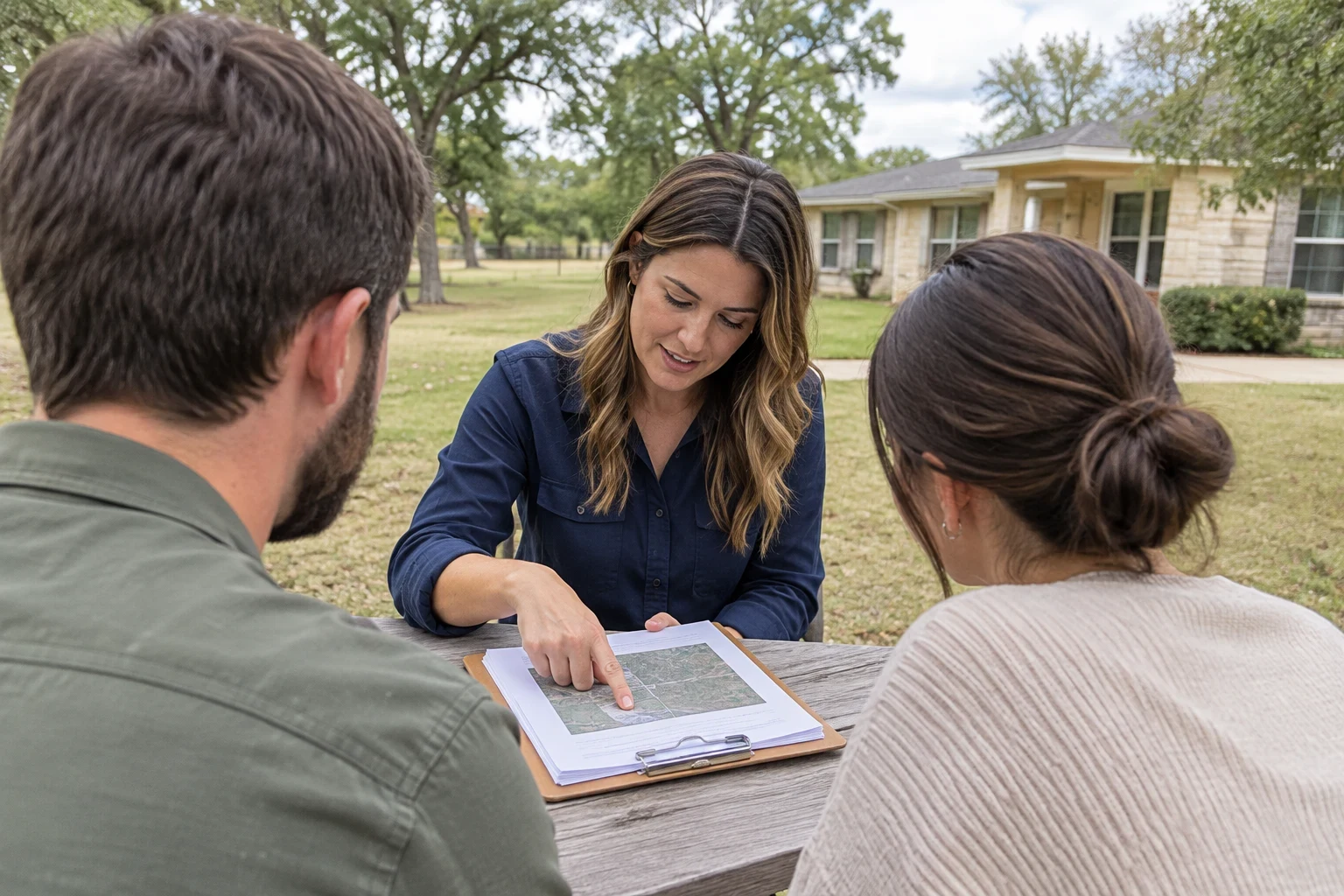
What a USDA loan is and who it fits
This is a home loan guaranteed by the U.S. Department of Agriculture. The program aims at buyers in eligible areas away from crowded city centers. You do not need a down payment, and the rate often holds up well against other low-down loans.
Your fit comes down to two checks. First, the property must fall inside an eligible area on the USDA map. Second, the total income of every adult living there must stay under the county limit. A lot of buyers around Hutto skip this program thinking it is meant for farmland. That is a myth. It works for regular single-family houses you live in full time.
We have held our NMLS license for 10 years, and we will say so early if USDA does not suit you. When that happens, we lay out FHA Loans or Conventional Loans as the next options.
What we handle on a USDA loan
Address eligibility check
We look up the exact address on the USDA eligibility map. You get a screenshot of the result, so you know before you write an offer.
Income limit review
USDA counts the income of every adult who will live in the house, not just the borrowers. We add it up with you and show the math against the county limit.
Pre-qualification and pre-approval
We review credit, debts and pay history, then issue a pre-approval your agent can send with offers.
Document tracking with copies
Every condition the underwriter asks for goes on a list. When it clears, we send you a copy of what was submitted and the note that it was accepted.
Appraisal follow-through
USDA appraisals check basic safety and condition along with value. If the appraiser flags something, we send you the page and explain what the seller needs to address.
Signs a USDA loan may be the right call
Little saved for a down payment
You have steady income but not much in savings. USDA removes the down payment hurdle entirely.
Moderate income
Your family income is solid but not high. Many working families land under the limit without realizing it.
Shopping outside the busiest areas
You are looking at newer subdivisions or edge-of-town streets. Some of these sit inside eligible zones, so the address check matters.
Buying a place to live in
USDA is for a primary residence only. If this is the house you will live in full time, it is worth checking.
Credit that is fair, not perfect
You have a few dings but pay bills on time now. We can tell you where you stand after one review.
How a USDA loan moves from first call to closing
- 1
First call
We go over your income, debts, savings and where you want to buy. By the end, most callers know whether USDA is worth chasing.
- 2
Application and pre-approval
We take your loan application over the phone, asking the questions and entering your answers as we talk. Then we pull credit, gather pay stubs, W-2s and bank statements, and send your pre-approval along with a list of everything we looked at.
- 3
Contract and appraisal
After your offer is accepted, we run the address through the map one more time and order the appraisal. The report goes to you as soon as we have it.
- 4
Underwriting and USDA review
Your file clears our underwriting first, then waits on USDA to approve the guarantee. Because that second review is slower, we build extra days into the schedule and give you the realistic closing date at the start.
- 5
Closing
Your Closing Disclosure arrives before closing day so you can hold it up against your Loan Estimate. If any number moved, we explain it before you sign.
What moves the cost of a USDA loan
Zero down is not the same as zero cost. You still pay an upfront guarantee fee, a yearly fee split into your monthly payment, normal closing costs and interest at your rate. Each of these shows up on your Loan Estimate, and we read through it with you one line at a time.
- Guarantee fees
- The program carries two fees: one charged upfront and one charged each year. Most borrowers add the upfront fee to the loan balance so they do not pay it in cash.
- Credit and debt load
- Your credit history matters, and so does the share of your paycheck already going to debts. Both affect your rate and whether underwriting looks harder at the file.
- Closing costs and seller help
- The title work, the appraisal and the prepaid property taxes and insurance all come due at closing. A seller can often agree to pay some of that, which lowers the cash you need that day.
- Timing and rate lock
- Rates change week to week. The length of your lock and the time the USDA review takes both shape what you pay in the end.
USDA loan questions we hear
Something not covered here? (512) 518-6206
Is a USDA loan only for farms or rural land?
No. Ordinary single-family houses qualify when they sit in an eligible area, and that includes plenty of suburban streets. You just have to live there as your primary residence.
Does the address I like qualify?
Give us the exact address and we look it up on the USDA map, then send you a screenshot of the result. The boundaries get updated from time to time, so we look it up a second time after you sign a contract.
Whose income counts toward the limit?
USDA adds up what every adult planning to live in the house earns, including anyone who is not on the loan. A grown child with a job or a parent with a pension still gets added in. When we figure whether the monthly payment fits your budget, only the people signing the loan are counted.
Why does a USDA closing run longer than other loans?
After our underwriter signs off, the file goes to USDA for its own guarantee review, and that extra stop takes time. A conventional loan skips it. We give you a timeline before you sign a purchase contract so the closing date you pick is one we can hit.
Can I buy a fixer-upper with a USDA loan?
The appraiser checks that the house meets basic safety and condition standards. Minor items a seller fixes before closing are usually fine. A house needing major work is generally not a good match for this program.
Find out if USDA works for you
One phone call tells us whether the address and your income line up with the program. From there we start your application and send you a copy of each step as it clears.